We’ve all been there. You fill out a form, and it asks for your “Date of Birth.” You do the mental math, write down the number, and… wince. Is that really how old I am?
Maybe you’re 40 but feel 25, especially when your favorite 90s song comes on. Or maybe you’re 22 but feel 40, thanks to a mortgage, two jobs, and a deep appreciation for a quiet night in.
This brings up a fascinating question: What is age, really?
We’re constantly bombarded with different “ages.” You hear about “biological age,” “mental age,” and even “your skin’s age.” But through all this noise, there’s one number that’s fixed, unchanging, and totally objective.
It’s your chronological age.
This is the number that gets you birthday cake. It’s the one on your driver’s license, your passport, and every single legal document you own. It is, for all intents and purposes, your “official” age.
But what does it actually mean? Why is it so important? And how is it so different from how you feel?
Welcome to the complete guide on chronological age. We’re going to break down this simple-sounding topic into everything you need to know. We’ll cover:
- The simple definition of chronological age.
- How it’s calculated (and why it’s not always simple).
- The massive difference between chronological age and biological age.
- Why this one number dictates your legal rights, medical care, and education.
- When “age is just a number” is actually true (and when it’s not).
Let’s dive in.
The Straight-Up Definition: What is Chronological Age?
In the simplest terms, chronological age is the exact amount of time a person has been alive since their birth.
That’s it. It’s a literal measure of time.
- It’s measured in years, months, and days.
- It’s based on the calendar, not on your health, feelings, or life experience.
- It’s 100% objective. You can’t change it, negotiate with it, or “improve” it.
If you were born on October 25, 2000, then on October 25, 2025, your chronological age is exactly 25 years. It doesn’t matter if you run marathons or if you just woke up from a 10-hour nap. The calendar has ticked by, and that’s your score.
Think of it like a car’s odometer. It just counts the miles (or in this case, the years). It doesn’t tell you if those miles were on a smooth highway or a bumpy dirt road. It just tells you how long the engine has been running.
How to Calculate Your Chronological Age (The ‘Official’ Way)
This sounds almost too simple, right? “I just know my birthday.”
And for casual conversation, that’s fine. When someone asks how old you are, you just give the number of full years you’ve completed.
But in medical, legal, and academic settings, “age” needs to be precise—right down to the day. This is how it’s really calculated. It’s a simple subtraction problem:
Today’s Date – Your Date of Birth = Your Chronological Age
Let’s do a quick example.
Let’s say Today’s Date is: October 25, 2025
And Your Birth Date is: March 15, 1990
We’d set it up like this, just like in grade school math:
  YYYY / MM / DD
  2025 / 10 / 25
- 1990 / 03 / 15
------------------
  0035 / 07 / 10
Your precise chronological age is 35 years, 7 months, and 10 days.
But What If You Need to “Borrow”?
This is where it gets a tiny bit tricky. What if the day or month number in your birth date is bigger than today’s? You have to “borrow” from the column to the left.
Let’s try a new example.
Today’s Date: June 10, 2025
Your Birth Date: August 28, 1992
Step 1: Set up the problem
  YYYY / MM / DD
  2025 / 06 / 10
- 1992 / 08 / 28
------------------
Step 2: Subtract the Days
You can’t subtract 28 from 10. So, you need to “borrow” from the Month column.
We take 1 month from “06” (making it “05”). We add that month’s days to the Day column. (We’ll use 30 as a standard average, though some systems use the exact number of days in the previous month).
Let’s add 30 days to 10, which gives us 40.
40 - 28 = 12 days
Now the problem looks like this:
  YYYY / MM / DD
  2025 / 05 / 40  (We borrowed 1 month = 30 days)
- 1992 / 08 / 28
------------------
                 12
Step 3: Subtract the Months
Now we have to subtract 8 from 5. Can’t do it. We have to borrow from the Year column.
We take 1 year from “2025” (making it “2024”). We add that year’s 12 months to the Month column.
12 + 5 = 17 months
Now, 17 - 8 = 9 months.
Step 4: Subtract the Years
This one is easy now: 2024 - 1992 = 32 years.
Final Answer: Your precise chronological age is 32 years, 9 months, and 12 days.
Phew. Kind of a hassle, right?
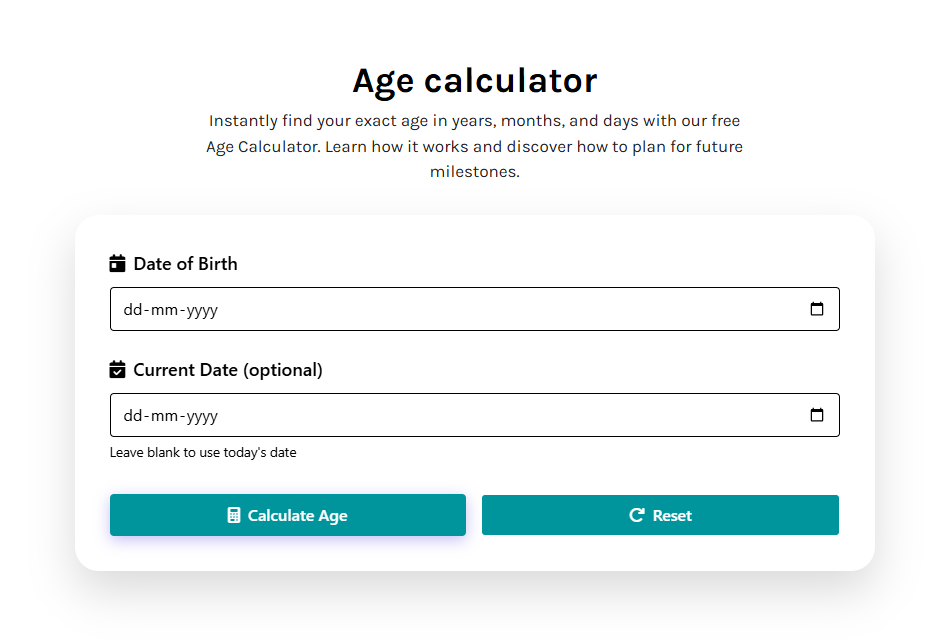
This is exactly why most of us just use an online age calculator. (And yes, if you want the fast-pass, an age calculator tool—like the one right here on our site!—can do this math in a fraction of a second.) But now you know the official logic that happens behind the scenes.
Chronological Age vs. The “Other” Ages: Why It Gets So Confusing
Here’s the real meat of the issue. The reason “chronological age” even needs a special name is that we have all these other ways of measuring age.
Your chronological age is a fact. But these other ages are measurements. They tell a much more personal story.
Chronological Age vs. Biological Age (The Big One)
This is the most important distinction in all of health and wellness.
- Chronological Age: How many candles are on your cake.
- Biological Age: How old your body acts and feels. It’s a measure of your body’s actual health, vitality, and wear-and-tear at a cellular level.
Think about two 60-year-old men.
- Man A (Chronological Age: 60): Smokes, eats a poor diet, doesn’t exercise, and is under a lot of stress. He has high blood pressure, stiff joints, and low energy. His biological age might be closer to 75.
- Man B (Chronological Age: 60): Eats well, exercises, sleeps 8 hours, and manages stress. He’s active, has great energy, and his medical checkups are fantastic. His biological age might be closer to 45.
They have the same chronological age, but their life experiences and health outcomes are worlds apart.
What influences your biological age?
- Genetics: Your DNA plays a role, but it’s not the whole story.
- Lifestyle: This is the big one. Diet, exercise, sleep, and habits (like smoking or drinking) have a massive impact.
- Environment: Things like pollution, access to clean water, and even your social circle can affect your cellular health.
- Stress: Chronic stress literally ages your cells faster.
Scientists measure biological age by looking at “biomarkers,” like telomere length (the protective caps on your DNA), inflammation levels, and DNA methylation (how your genes are expressed).
The takeaway: You can’t change your chronological age. But you have significant control over your biological age.
Chronological Age vs. Mental Age (or Cognitive Age)
This refers to how “old” your brain functions. It’s a measure of your cognitive abilities—like memory, problem-solving, learning speed, and reasoning—compared to the average for a specific chronological age group.
- This term was originally developed for psychology, often in the context of IQ testing (e.g., “A child of 8 with the problem-solving skills of a 10-year-old”).
- In adults, we often call this “cognitive age.” You’ve heard people say, “I’m 70, but my mind is as sharp as a 40-year-old’s!” They are describing a young cognitive age.
Like biological age, you can influence this. “Use it or lose it” is very real. Reading, learning new skills, social engagement, and even puzzles can help keep your cognitive age low.
Chronological Age vs. Social Age
This one is all about society’s expectations.
Social age is the set of unwritten rules and cultural norms about when you’re supposed to do certain things.
- When are you “supposed to” graduate from college?
- When are you “supposed to” get a “real” job?
- When are you “supposed to” get married?
- When are you “supposed to” have kids?
- When are you “supposed to” retire?
Your social age is how you line up with those expectations. If you’re 30 and just starting college, your social age might be “younger” than your peers. If you’re a 25-year-old CEO, your social age might be “older.”
The good news? These “rules” are becoming more and more flexible. People are starting second (or third!) careers in their 50s, having kids later, and retiring earlier. Your chronological age doesn’t have to lock you into a specific life path.
Chronological Age vs. Emotional Age (Maturity)
You definitely know this one.
We’ve all met a 45-year-old who throws a tantrum like a 4-year-old when they don’t get their way. We’ve also met a 15-year-old who handles responsibility and difficult conversations with the grace of a 30-year-old.
- Emotional Age (or Emotional Maturity): This is about how you understand, process, and manage your emotions. It’s about your level of self-awareness, empathy, and your ability to handle life’s challenges responsibly.
Your chronological age gives you experience, but it doesn’t automatically give you wisdom. Emotional maturity is something you have to actively build.

Why Your Chronological Age is Still So Important
Okay, so we’ve established that your biological and emotional ages are arguably more important for your quality of life.
So why do we obsess over this one “official” number?
Because chronological age, for all its flaws, is the only objective, universal, and easily verifiable standard we have. It’s the framework our entire society is built on. It’s not a perfect system, but it’s the one we’ve got.
Your chronological age is your passport to society. It dictates your rights, your responsibilities, and your access to different systems.
The Legal Framework: Your Official “Level-Up” System
From the moment you’re born, a clock starts. And at specific, pre-determined chronological milestones, you “unlock” new legal rights and responsibilities.
- Age 5-6: Right to public education (starting kindergarten).
- Age 14-16: Right to get a job (varies by state/country).
- Age 16-18: Right to drive a car.
- Age 18: This is a big one. The “age of majority.”
- Right to vote.
- Right to sign contracts.
- Right to join the military.
- Considered a legal adult.
- Age 21: (In the US) Right to legally purchase alcohol.
- Age 25: (In the US) Right to run for the House of Representatives.
- Age 62-67: Right to access retirement benefits (like Social Security or pensions).
Imagine the chaos if these were based on “biological age” or “emotional maturity.” How would you prove it? A “maturity test” to get a driver’s license? It’s just not practical. So, we use chronological age as the great equalizer.
The Medical System: A Starting Point for Diagnosis
Your doctor always asks for your date of birth. This isn’t just for their records; your chronological age is a primary data point for your health.
Developmental Milestones
For babies and children, this is everything. A doctor’s chart is all about chronological age:
- “At 2 months, can they lift their head?”
- “At 1 year, are they starting to walk?”
- “At 2 years, are they forming 2-word sentences?”These milestones are a critical tool for identifying potential developmental delays.
Vaccination Schedules
Vaccination schedules are based purely on chronological age. You get specific shots at 2 months, 4 months, 6 months, 1 year, etc.
Medical Screening Guidelines
This is a big one for adults. Health organizations use massive population studies to determine when the risk of a certain disease becomes high enough to warrant screening.
- Age 21: Recommended to start cervical cancer screening.
- Age 45-50: Recommended to start colonoscopies.
- Age 40-50: Recommended to start regular mammograms.
- Age 55: Recommended to start lung cancer screening (for high-risk individuals).
Your chronological age is the first and most important risk factor for many of
life’s most common diseases, like heart disease, cancer, and arthritis.
The Education System: How We Group Students
Why is your 7-year-old in a class with other 7-year-olds? Chronological age.
The entire global education system is built on this. We group children by their birth year and move them through a standardized curriculum.
Is this system perfect? No. A 7-year-old who reads at a 10-year-old’s level might be bored. Another 7-year-old might need more time. But it’s the most manageable way to educate billions of people.
The “Age is Just a Number” Debate: When Chronological Age Fails Us
You’ve heard the phrase. Sometimes it’s inspiring. Sometimes it’s a denial of reality.
So, when is it actually “just a number”?
This phrase is a pushback against the limitations and stereotypes that we attach to chronological age.
The Problem with Stereotypes (Ageism)
The biggest failure of chronological age is ageism. This is when we make unfair assumptions about someone based on their number.
- “He’s only 23, he can’t possibly lead this team. He’s too young.”
- “She’s 68. She probably won’t understand how this software works.”
- “You’re 35 and not married? What’s wrong with you?”
This is where chronological age is incredibly unhelpful. It tells you nothing about a person’s skill, wisdom, energy, or value. A 70-year-old can be a groundbreaking scientist, and a 25-year-old can be a wise and empathetic leader.
In the workplace, in social life, and in relationships, relying on chronological age to judge a person’s capability is a massive mistake.
The “Health” Illusion
This is the second major failure. If you rely only on your chronological age to gauge your health, you’re missing the whole picture.
You might think, “I’m only 32. I’m young! I can eat whatever I want and skip sleep.”
But if you do that, your biological age will skyrocket. Your arteries, your organs, and your brain will be aging much faster than the calendar.
Conversely, a 65-year-old who thinks, “Well, I’m old, I’m supposed to have aches and pains and be tired,” is doing themselves a disservice. By focusing on improving their biological age through diet, movement, and sleep, they could feel better than they did at 45.
Chronological Age Around the World: It’s Not Always Calculated the Same!
This is a fascinating bit of trivia that shows how “age” is partly a cultural concept. For most of the world, the system we’ve discussed (you are “0” at birth, you turn “1” on your first birthday) is the standard. This is the international age system.
But it wasn’t always the only way.
East Asian Age Reckoning (Korean Age)
Until very recently (June 2023!), South Korea used a different system that made everyone 1 or 2 years older than their international age.
It worked in two ways:
- You are “1” at birth: This counted the ~9 months of pregnancy as the first year of life.
- Everyone gets 1 year older on January 1st: Your birthday didn’t make you “age up.” The New Year did.
This led to some wild situations. If a baby was born on December 31st, they were 1 year old. The next day, January 1st, they turned 2… even though they were only two days old in international age!
This system was also used in China, Japan, and other parts of East Asia, but most had moved to the international system. South Korea was the last major country to officially switch, all to reduce social and legal confusion.
It’s a perfect example of how chronological age, while based on the fact of your birth, is still a human-made system.
The Big Picture: A Table Comparing Age Types
Let’s put it all together. Here’s a simple table to help you remember the key differences.
| Age Type | What It Measures | How It’s Measured | Can You Change It? |
| Chronological Age | The total time you have been alive. | The calendar (Today’s Date – Birth Date). | No. It’s a fixed, historical fact. |
| Biological Age | The health and “age” of your body’s cells. | Medical biomarkers (telomere length, DNA, etc.). | Yes! Hugely influenced by diet, exercise, and lifestyle. |
| Mental / Cognitive Age | Your brain’s functional abilities (memory, problem-solving). | Cognitive tests compared to population averages. | Yes. Can be maintained or improved with “brain exercise.” |
| Social Age | Your “place” in life compared to cultural expectations. | Comparing life milestones (career, marriage) to norms. | Yes. You can follow or defy social timelines. |
| Emotional Age | Your level of emotional maturity and self-regulation. | Observing behavior, empathy, and responsibility. | Yes. Actively developed through self-awareness. |

Conclusion: What Your Chronological Age Really Means for You
So, after 3,000 words, what’s the final verdict?
Your chronological age is your story’s timestamp. It’s the unchangeable fact of when you started. It’s the official, legal, and medical framework for your life. You need it for your driver’s license, your doctor’s appointments, and your retirement party.
But that’s where its power ends.
It does not define your health. That’s your biological age.
It does not define your wisdom. That’s your emotional age.
It does not define your sharpness. That’s your cognitive age.
And it absolutely does not define your worth.
The most important takeaway is this: You are the author of your life, not the calendar.
Treat your chronological age as a fact, but live by your biological and mental age. Use the number when you have to, but don’t let the number use you.
Frequently Asked Questions (FAQ) About Chronological Age
1. What is the simple definition of chronological age?
Chronological age is the most common way we measure age. It is simply the amount of time that has passed from the moment you were born until today, usually measured in years, months, and days. It’s the “official” age on your passport or driver’s license.
2. Is chronological age the same as biological age?
No, they are very different. Your chronological age is fixed by the calendar (how long you’ve been alive). Your biological age is a measure of your body’s actual health and “wear and tear” at a cellular level. You can be 50 chronologically but have the biological age of a 40-year-old through a healthy lifestyle.
3. Can I change my chronological age?
No. Your chronological age is a historical fact based on your date of birth. It cannot be changed. However, you can take steps to lower or improve your biological age, cognitive age, and emotional age.
4. Why do doctors and lawyers always ask for my chronological age?
They use chronological age as a universal, objective standard. Medically, it’s used to determine risk factors, create vaccination schedules, and set guidelines for health screenings (like colonoscopies at 45). Legally, it determines your rights and responsibilities, such as the age to vote, drive, or access retirement benefits.
5. How is chronological age calculated differently in some cultures?
While most of the world uses the “international age” system (you are 0 at birth), some cultures, like in East Asia, historically used a different system. In the traditional Korean system, a baby was “1” at birth (counting time in the womb) and everyone aged up one year together on New Year’s Day. This system is no longer in official use.